Robin’s Captivity under Troy
Gang Up: A Bikerland NovelRobin’s captivity under Troy places her in the path of his plans for power: confined and unable to leave, she knows enough to threaten exposure, while Troy answers by making clear that he intends to keep her silent. The imprisonment ends when Brall finds her in a secured corner of the captured water facility and frees her, turning the episode from enforced helplessness into a fraught reunion shaped by both danger and unresolved feeling.
Confinement and Threat
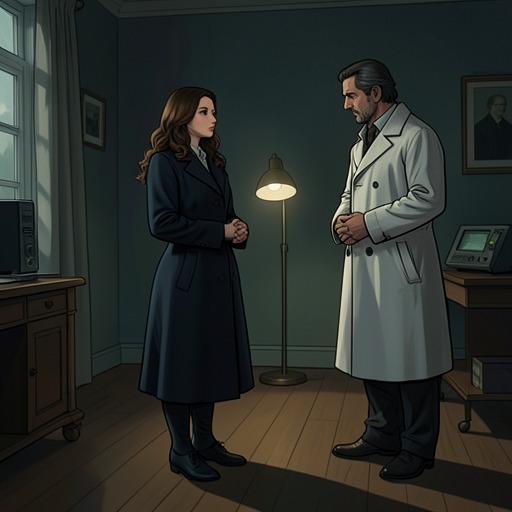
Troy’s control is made physical when Potter takes Robin’s arms, locks them behind her, and fastens a pair of handcuffs around them. Robin understands the likely answer before Troy gives it: she says she will expose him, but he grins and tells her she is not going anywhere. The exchange makes the purpose and immediate effect of the restraints plain. Robin can speak against him, but she cannot leave to make good on the threat.
Her helplessness is reinforced by Troy’s confidence in the surrounding power imbalance. He dismisses the possibility that anyone will hear her accusation and treats her continued presence as assured. The restraint is not merely a temporary obstacle; in this moment, Troy controls both her movement and her access to an audience. Robin’s declaration still matters, however, because it identifies what she intends to do if she can escape: make his actions known.
The Captivity Within Troy’s Plot
Robin’s confinement takes place amid a larger scheme that she has begun to understand. She knows Troy was responsible for starting the explosions, and recognizes pleasure, rather than guilt, in his manner. He tells her that none of his men died in the attacks and presents the changing numbers on his side, including Case’s expected support, as the practical measure that matters. His treatment of Robin is thus set against a political calculation in which people and allegiances are counted as assets.
Troy also uses the conversation to threaten what may follow. He insults Robin and Brall, then describes Brall’s anticipated death and suggests that Case could die in the fighting and be remembered as having fallen in the line of duty. This is Troy’s stated scheme, not an outcome established in the captivity scene. Robin’s promise to expose him directly challenges the secrecy on which such a plan depends; the handcuffs and Troy’s assurance that she cannot go anywhere close off her immediate chance to act on it.
Discovery and Release
After the fighting at the water source, Brall surveys the rooms he now controls. He finds Robin locked away in a back corner, her hands tied behind her. The water facility matters to him as a strategic possession: its clean stream comes from a cave deep in the rocks, and a steady nearby supply would keep his people from weakening. Yet the discovery of Robin immediately interrupts that appraisal. He wonders why his men did not tell him she was there and whether she has been hurt or frightened by the fighting.
Brall’s first impulse is to comfort her, but he consciously reins in his anger and approaches carefully. He kneels to ask how she came to be there; despite kneeling, he remains much taller than her. Her bindings are metal, and he undoes them with ease before tossing them aside. The physical contrast is decisive: Troy’s restraints had made Robin’s escape impossible, while Brall can remove them almost effortlessly. Her release ends the period of confinement, though it does not settle what their relationship means.
Reunion and Unresolved Feeling
Once freed, Robin asks Brall whether he came for her and wanted her back. Her question exposes the emotional uncertainty that survives the rescue: she needs to know that their feelings were real, and Brall recognizes that need because he shares it. Instead of answering with the reassurance she seeks, he says that he wanted the water and the town. The answer keeps his strategic aims in the foreground and leaves her personal question unanswered at that point.
Robin then tests what Brall’s release of her means by challenging his desire and his capacity to claim her, invoking her recent sexual treatment by other men. Brall’s response is playful but dangerous, and the narration describes anger and lust converging in his desire for her. That charged exchange belongs to the aftermath, not to Troy’s imprisonment itself; it shows that freedom from Troy does not make Robin’s next encounter uncomplicated. The captivity’s narrative significance lies in this transition: Troy uses confinement to suppress a witness and preserve his plans, while Brall’s intervention restores Robin’s physical freedom without immediately resolving the emotional and sexual tensions she brings out of captivity.